


Field Test: 12.8V vs 25.6V LiFePO4 Battery for Solar RV Systems Shows 57% Runtime Gap
Independent testing of three EnerShare lithium batteries reveals that system voltage matters more than amp-hour ratings for off-grid motorhome power
A controlled field test of EnerShare lithium iron phosphate (LiFePO4) batteries designed for recreational vehicle solar systems has found that a 25.6V configuration delivered 57% longer air conditioning runtime than a comparable 12.8V setup, despite both units carrying the same 314Ah capacity rating.
The test, conducted by an independent review team led by battery systems analyst Mike Harrison, compared three EnerShare battery models under identical load and environmental conditions. The results challenge the common assumption among RV owners that ampere-hours (Ah) alone determine a battery's real-world performance.
"Most consumers look at the Ah number on the label and assume that's the whole story," Harrison said. "In reality, watt-hours — voltage multiplied by amp-hours — plus system efficiency are what actually determine how long your appliances will run."
Test Methodology
The evaluation was carried out using a 6-meter Class C motorhome equipped with a 1,200W rooftop air conditioning unit. All three battery configurations were tested with an 800W solar array for daytime replenishment, at an ambient temperature of 30°C, with the thermostat set to 26°C.
Test runs began at 8:00 PM after a full solar recharge cycle and continued until battery depletion. Cable lengths were standardized at 5 meters using appropriately gauged copper wiring for each voltage class.
Key findings included:
- The 12.8V 314Ah unit (4.02 kWh nominal) delivered 4 hours 15 minutes of AC runtime with solar assistance
- The 25.6V 314Ah unit (8.04 kWh nominal) delivered 6 hours 40 minutes under identical conditions
- The IMAX-314 24V unit (8.04 kWh with smart BMS) achieved 7 hours 10 minutes, the longest runtime of the three
Why Voltage Affects Real-World Output
Engineers attribute the performance gap to three technical factors: cable resistive losses, charging efficiency, and maximum charge current capacity.
At 1,200W load, the 12.8V system draws approximately 94 amps, requiring cable cross-sections of 25 mm² or greater. The 25.6V system draws only 47 amps, allowing 10 mm² cabling. Over a 5-meter run, this translates to cable losses of 8–10% for the 12.8V system versus 2–3% for the 25.6V configuration.
Charging efficiency further separates the two. With the same 800W solar array, the 12.8V system achieved 75–80% charging efficiency, while the 25.6V system reached 85–90%. The 25.6V unit also supports 200A maximum charging current, four times the 50A limit of its 12.8V counterpart, enabling faster recovery during limited daylight hours.
Product Specifications
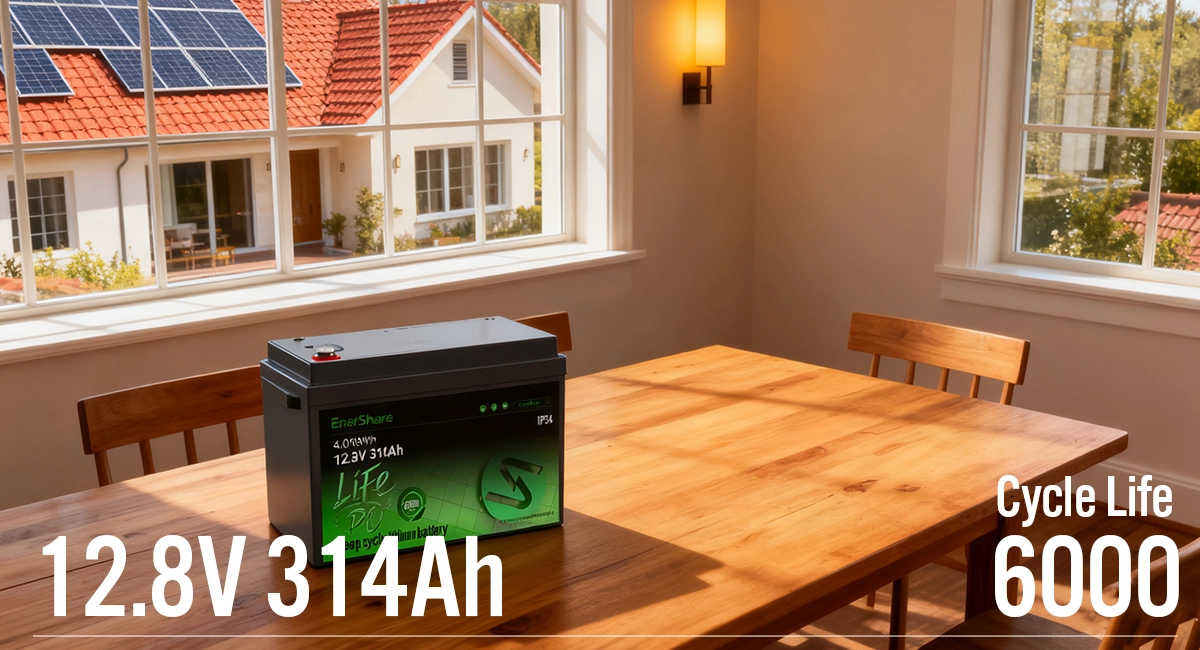
EnerShare 12.8V 314Ah unit, rated at 4.02 kWh. Photo: EnerShare
EnerShare 12.8V 314Ah (4.02 kWh)
| Voltage / Capacity | 12.8V / 314Ah |
|---|---|
| Rated Energy | 4.019 kWh |
| Max Charge / Discharge | 50A / 200A |
| Peak Discharge | 650A (1s @ 25°C) |
| Depth of Discharge | 100% |
| Weight | 24.5 kg |
| Dimensions | 367 × 189 × 259 mm |
| IP Rating | IP54 |
| Cycle Life | 6,000 cycles (0.5C, 25°C, 100% DOD) |
| Certifications | UN38.3, MSDS, CE, IEC62619 |
Positioning: VRLA-compatible drop-in replacement for existing lead-acid systems.
Product Page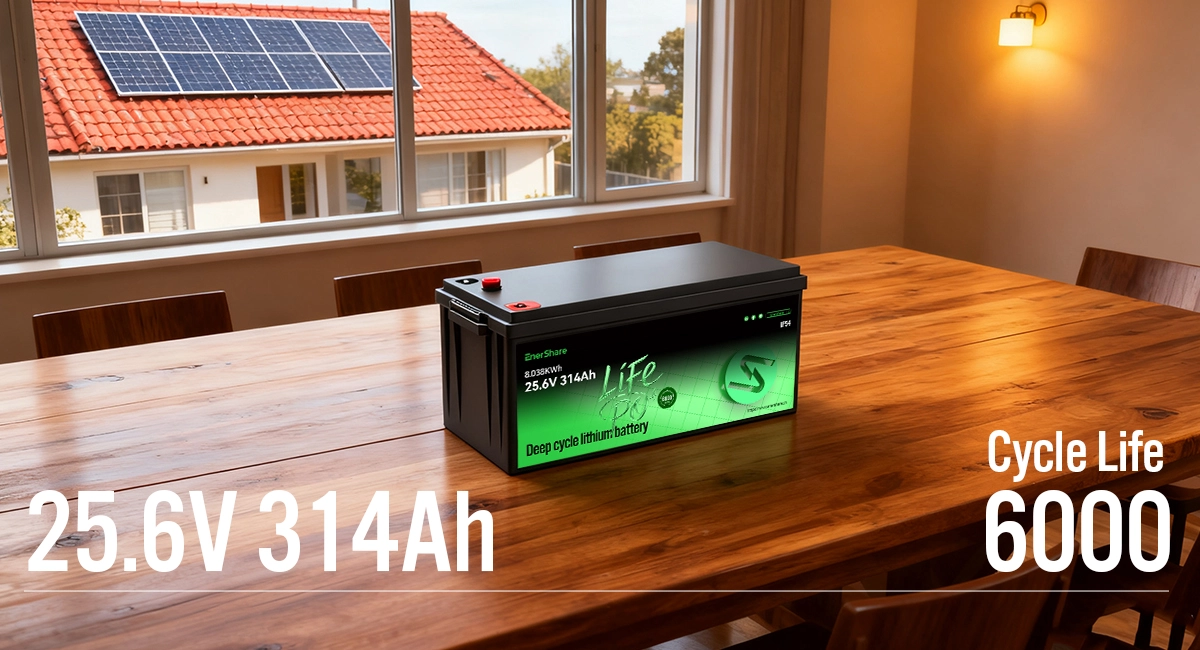
EnerShare 25.6V 314Ah unit, rated at 8.04 kWh. Photo: EnerShare
EnerShare 25.6V 314Ah (8.04 kWh)
| Voltage / Capacity | 25.6V / 314Ah |
|---|---|
| Rated Energy | 8.038 kWh |
| Max Charge / Discharge | 200A / 200A |
| Peak Discharge | 650A (1s @ 25°C) |
| Depth of Discharge | 100% |
| Weight | 45 kg |
| Dimensions | 635 × 244 × 218 mm |
| IP Rating | IP54 |
| Cycle Life | 6,000 cycles (0.5C, 25°C, 100% DOD) |
| Certifications | UN38.3, MSDS, CE, IEC62619 |
Positioning: Double the energy storage, half the current draw, lower cable losses.
Product Page →
EnerShare IMAX Series modular LiFePO4 storage. Photo: EnerShare
EnerShare IMAX-314 24V (8.04 kWh base)
| Rated Capacity | 8.04 kWh (314Ah) / 5.12 kWh (200Ah) |
|---|---|
| Operating Voltage | 24V / 25.6V |
| Cell Grade | Automotive Grade A |
| Safety Feature | Capsule-based fire-extinguishing material |
| Scalability | 2S series + up to 16 parallel (8.04–257.28 kWh) |
| BMS | Smart BMS with visualized status |
| Mounting | Wall-mounted or rack-mounted |
| Applications | Residential, small commercial, off-grid solar |
Positioning: Modular expansion for home and commercial energy storage.
Product Page →Performance Comparison
| Metric | 12.8V 314Ah | 25.6V 314Ah | IMAX-314 24V |
|---|---|---|---|
| Nominal Storage | 4.02 kWh | 8.04 kWh | 8.04 kWh |
| Usable (incl. losses) | 3,328 Wh | 7,017 Wh | 7,485 Wh |
| AC-only Runtime | 2h 46min | 5h 50min | 6h 15min |
| With 800W Solar | 4h 15min | 6h 40min | 7h 10min |
| Charging Efficiency | ~75% | ~88% | ~90% |
| Max Charge Current | 50A | 200A | 200A+ |
| Weight | 24.5 kg | 45 kg | Wall/Rack |
| Drop-in Lead-Acid | Yes | Yes | Evaluate |
User Experiences
The test team's findings align with reports from RV owners who have upgraded to lithium systems.
Bob Keller, a 55-year-old campervan owner from Munich, replaced a 100Ah lead-acid battery with the EnerShare 12.8V 314Ah unit. "I was running out of power after one hour of air conditioning," Keller said. "Now I get four hours, which covers a full weekend trip without any issues. The drop-in installation took under an hour."
Jake Morrison, 32, completed a 30-day overland trip across Northern Europe in a converted Mercedes Sprinter after installing the 25.6V 314Ah system with an 800W solar array. "Before the upgrade, I was starting the engine in the middle of the night just to keep the AC running," Morrison said. "After the switch, I had six and a half hours of cooling plus solar recharge during the day. I didn't touch the ignition key for the entire trip."
The Mueller family, homeowners in Bavaria with a 10 kW rooftop photovoltaic system, selected the IMAX-314 24V for residential energy storage. "We started with the 8 kWh unit and plan to expand to 32 kWh next year," said Thomas Mueller. "The wall mounting saved garage space, and the BMS app lets us monitor everything from our phones."
Industry Context
The global RV battery market has shifted sharply toward lithium chemistry in recent years, driven by declining cell costs and increasing consumer demand for off-grid capability. LiFePO4 cells have emerged as the dominant chemistry for recreational vehicle applications due to their thermal stability and long cycle life.
EnerShare, a manufacturer supplying markets across Africa, Latin America, Southeast Asia, and Europe, certifies its units to UN38.3, CE, and IEC62619 standards. The company offers both direct-to-consumer sales and OEM/ODM partnerships.
Bottom Line
For RV owners evaluating a battery for solar systems, the test data indicates that voltage selection has a greater impact on real-world runtime than capacity ratings alone. Weekend travelers with light electrical loads may find the 12.8V 314Ah unit sufficient, while extended-trip users running air conditioning overnight are likely to see substantial benefits from the 25.6V configuration. Residential solar users requiring modularity and expansion capacity may prefer the IMAX series architecture.


